


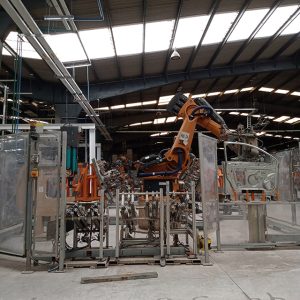
Robotic welding islands represent the convergence of robotic technology and welding in industrial environments. These specialized areas are designed to automate the welding process using industrial robots instead of human labor. This integration offers significant benefits in terms of efficiency, precision, and safety.
In a robotic welding island, the key elements include:
Welding robots: These robots are equipped with welding torches and are programmed to perform welding operations according to project specifications. The robots can move precisely and repetitively, ensuring high quality and consistency in the welds.
Artificial vision systems: Some robotic welding islands are equipped with artificial vision systems that allow the robots to accurately detect the position and orientation of the parts to be welded. This is particularly useful in applications where parts may vary slightly in size or position.
Clamping and fixation devices: Just like in traditional welding islands, clamping and fixation devices are used to hold the parts in place during the welding process.
Programming and control: The welding robots are programmed to perform welding operations according to the project specifications. Programs can be adjusted and modified as needed to accommodate different part geometries or welding requirements.
Safety systems: Safety systems are implemented to protect operators and ensure a safe working environment. This may include physical barriers, safety sensors, and emergency stop systems.
Robotic welding islands offer several advantages over traditional manual welding methods, including increased production speed, greater precision and consistency in welds, and a reduced risk of injury to workers. Additionally, by freeing workers from repetitive and dangerous tasks, robotic welding islands can improve morale and job satisfaction.
In summary, robotic welding islands are specialized areas within an industrial setting that use robotic technology to automate the welding process. These facilities offer significant benefits in terms of efficiency, quality, and safety in the production of welded components.